My Story
Black as the devil, Hot as hell, Pure as an angel, Sweet as love."~Charles Maurice de Talleyrand
I remember the times when I used to accompany mom around Beirut , in buying grocery from local shops, known in Lebanese as “dekkaneh”. Supermarkets back then weren’t ubiquitous. I used to nag about the fact that she would take me from shop to another till she finds that secret ingredient for the food that she wants to cook, or that special butchery that offers delicate meat.. But the only favorite part I used to get excited about was entering the Coffee Roaster. Just smelling the aroma of the bean roasting was the only thing that would shut me up. “Bin maa’ Heil” (. (Or coffee with cardamom) shouts my mom to the vendor over the machine. The picture in my head is pure : I stand below the machine , watch the vendor weighing the beans in a stainless steel bowl. I hear the beans hitting the stainless steel bowl, then the beans are devoured by the grinder. And here all the heavenly aromas are released.
She was ordering the Levant coffee which is based on the Turkish brewing method, and widely spread in Lebanon and Syria. This Turkish coffee is either roasted with cardamom or stays plain (qahwah sādah) according to the buyer’s taste.
Turkish coffee served by Mom for her neighbors or visitors was a daily habit. As I a grew older, I was allowed to drink the Turkish coffee, especially if I had exams during my high school years and I needed to overnight.
During the holy month of Ramadan , and as a Saudi Arabian tradition dictates, mom prepares the Arabic coffee ( made from green beans) after every fasting. It brings sooth after breaking the fast and eases digestion.Arabic coffeem makes its appearance in our house during more “ethnic” holidays such as Ramadan and Eid..Humans are indeed creatures of habits.
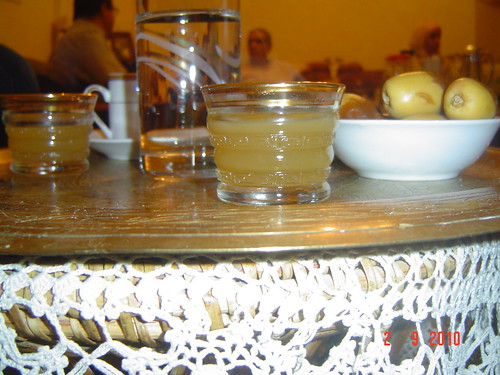
This Arabic coffee is characterized with the overwhelming aroma and flavor of cardamom, and sometimes other spices like saffron that usually gives it a golden color, as well as the odors of cloves, and sometimes cinnamon. It is mostly served with dates for the sugary taste, because sugar can’t be added to the coffee.
Coffee making is an alchemy by itself ; millions of varieties, different blends, distinct flavors , added ingredients like milk, chocolate,cream…etc ( Check this interesting infographic ) and even coffee choice depends on each one's taste (Coffee Matching according to taste : Coffee Matching)
But that’s not the whole story here. This is just my story. Coffee roasters aren’t wide spread anymore like a decade ago, coffee was replaced by vacuum packaged bags that can be just grabbed from any supermarket. There is no roasting. There is no overwhelming smell. The magic has gone.
And if one would analyze the reason behind this,it is because of the rise of prices of coffee.
The fresh roasted coffee mom bought costed only few dollars per kilogram, whereas now the kilograms costs atleast 20 dollars!
Blame it on the oil prices, blame it on global policies. Blame it on the industry. The coffee prices will continue to soar! But are coffee farmers gaining wealth with all this soar?
From now, I will talk about the story of the coffee beans from the farmers point of view. It is their story...
Showing posts with label prices. Show all posts
December 18, 2011
December 6, 2011
Is Lebanon Food Secure?
The Economics of Food Security in Lebanon
What comes to your mind when we say " food secure"? Do we mean that all Lebanese people have access to food? The answer is not quite positive.
Lebanese might eat everyday, but they might not quite eat good, or adequate amounts of the food.
Food security includes not just the availability of food but also entails the safety and nutrition of the food we eat.
Jane Harrigan, a political economist, consultant to the World Bank and FAO, and professor at the School of Oriental and African Studies (SOAS) at the University of London presented a lecture on November 30, 2011 on "The Economics of Food Security" which was sponsored by the Faculty of Agricultural and Food Sciences (FAFS) at AUB.
Harrigan stated that Lebanon's heavy dependence on imported food combined with massive hikes in global food prices between 2007 and 2008 have sparked increases in poverty. She added that the the average Lebanese household spends a large 20 to 30 percent of take-home income on food.
"Yes, domestic wheat production has increased significantly over the last 15 years but so has domestic demand due to population growth, income growth, and changing consumption patterns," warned Harrigan.
In 2009, the World Bank rated Lebanon as vulnerable in food security. The global rise in food prices and the fact that Lebanon is heavily dependent on import had some serious macro-economic effects: it led to inflation, a rising agricultural trade deficit, and a major negative social effect.
Between 2007 and 2008, the agriculture trade deficit as well as the cost of imported food increased 50 percent. Trade data suggests that Lebanon has a very strong revealed comparative advantage in the export of fruit and vegetables as well as wine and tobacco, added Harrigan.
From a purely economic perspective, if Lebanon wants to achieve food security by specializing in those areas where it has an international comparative advantage it should be focusing on exporting fruits vegetables and importing cereals that it doesn't have a comparative advantage in.
One Sentence that caught my attention was when Harrigan affirmed that "The global food crisis is one of the many propellers of the Arab Spring".....
Presentation Abstract
This presentation will look at the economic costs to Lebanon of the sharp rise in global food prices in 2007/08 in light of the country’s heavy dependence on food imports. It will assess the policy response to this in the form of renewed emphasis on domestic food production, particularly of cereals, and will ask whether such a policy is an economically efficient use of scarce domestic resources.About the speaker
Jane Harrigan is Professor of Economics at SOAS. She has worked and published extensively on the political economy of the MENA region as well as on sub-Saharan Africa. She is currently working on a project looking at food sovereignty in the Middle East funded by Georgetown University School of Foreign Service in Qatar. She is the author of eight books and has acted as a consultant to numerous international organizations, including the World Bank and FAO.Publication of the lecture: http://www.aub.edu.lb/communications/media/Documents/dec-11/food-security-world-bank-EN.pdf
Youtube Video:
AUB Lebanon http://youtu.be/yIUkAr-T77A
Subscribe to:
Posts (Atom)
